UNIT 1 PROJECT
By: Madelyn Pham
BROWN ADIPOSE CELLS
(Brown Fat Cells)
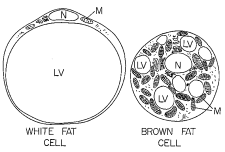
Brown adipose cells function primarily as energy consumers because of all the mitochondria they have while white adipose cells are primarily used for storage of energy because of the large amounts of fat they contain.
CELL
Brown adipose cells are one of two types of fat cells present in our body. Brown adipose cells varies in size of fat droplets, contain large amounts of cytoplasm, has numerous mitochondria, and round centrally located nuclei which differs drastically from a white adipose cell.
TISSUE
Adipose cells make up adipose tissue which helps conserve the heat of the body. adipose cells secrete fatty acids which can be used by muscles and tissues as a source of energy. fatty acids made up of brown adipose cells usually do not secrete instead they use cells' mitochondria for heat.
ORGAN
Enzymes contained in adipose cells generate fatty acids and glycerol for physiological processes. The fat stored in the cells comes directly from the fats eaten and is processed within the body from fats and carbohydrates in the food and sometimes from protein. The main fat in the body is the adipose tissue beneath the skin. There are also deposits of fat between the muscles, at the intestines and in their mesentery, which is around the heart, etc. One function of these deposits is to act as soft, elastic padding between the various organs.
ORGAN SYSTEM
Adipose tissue which is made of adipose cells is found underneath the skin and is also found around the internal organs.
INDIVIDUAL
Brown adipose cells use their many mitochondria to generate thermogenesis(heat) for hibernating animals or human infants. Adipose cells also synthesize and secrete complex fatty acid substances called prostanoids, which have various hormone like actions such as inhibiting the breakdown of fat, and a protein hormone called leptin, which plays a role in the regulation of metabolism, body weight, and reproductive function.
PROTEIN
Macromolecule
Precursor cells direct toward developing brown adipose cells by a specific protein, and, in the absence of this protein makes the precursor cells become muscle cells. Undifferentiated brown adipose cells contain RNA molecules that are similar to the RNA molecules of muscle cells.
CELL CYCLE
Adipose cells must copy itself twice before it matures and can't divide anymore.
INTERPHASE
A cell would take up more than half of their cell cycle time in this phase. In this phase a cell goes through G1, Synthesis, and G2.
PROPHASE
The cell take up the second most of the time here. The chromosomes of the cell condenses, the nuclear envelope breaks down, and crossing over occurs.
METAPHASE
The cell takes the third most time here. This is where the homologous chromosomes move to the equator of the cell.
ANAPHASE
This is the least time consuming phase the cell goes through. In anaphase, the homologous chromosomes move to the opposite poles of the cell.
TELOPHASE
This phase is the fourth most longest. In this phase the chromosomes gather at the poles of the cells and the cytoplasm divides. Since fat is considered an animal trait, a cleavage furrow is present in the division.
AUTOSOMAL RECESSIVE DISORDERS
To have an Autosomal Recessive Disorder you have to inherit 2 mutated genes and they both have to have one gene from each parent. The cause of this can be from the accumulation of fat and cholesterol cells in the liver, lungs, bone marrow, etc. What happens to the cell is, insulin decreases the concentration of glucose in the blood. After you eat a meal, blood glucose levels rise, triggering the secretion of insulin from cells in the pancreas. Insulin acts as a signal that triggers cells of the body, such as fat and muscle cells, to take up glucose for use as fuel.

WEBSITES USED IN THE MAKING
“Brown Fat Stem Cells – The Good Fat.” University of Utah Health, healthcare.utah.edu/the-scope/shows.php?shows=0_c75r894c.
“Brown Adipose Tissue.” Wikipedia, Wikimedia Foundation, 12 Dec. 2018, en.wikipedia.org/wiki/Brown_adipose_tissue.
“Autosomal Recessive: MedlinePlus Medical Encyclopedia.” MedlinePlus, U.S. National Library of Medicine, medlineplus.gov/ency/article/002052.htm.